
6.3 KiB
How to set up the exercises
Choose an approach
At the end of each lesson there may be an exercise that you may complete either:
- Within the page (uses Thebe) ↩
- In a separate online Jupyter lab environment (uses Binder) ↩
- Locally on your computer ↩
You may choose which approach you'd prefer then continue to the next page.
(exercises-setup:thebe)=
Thebe
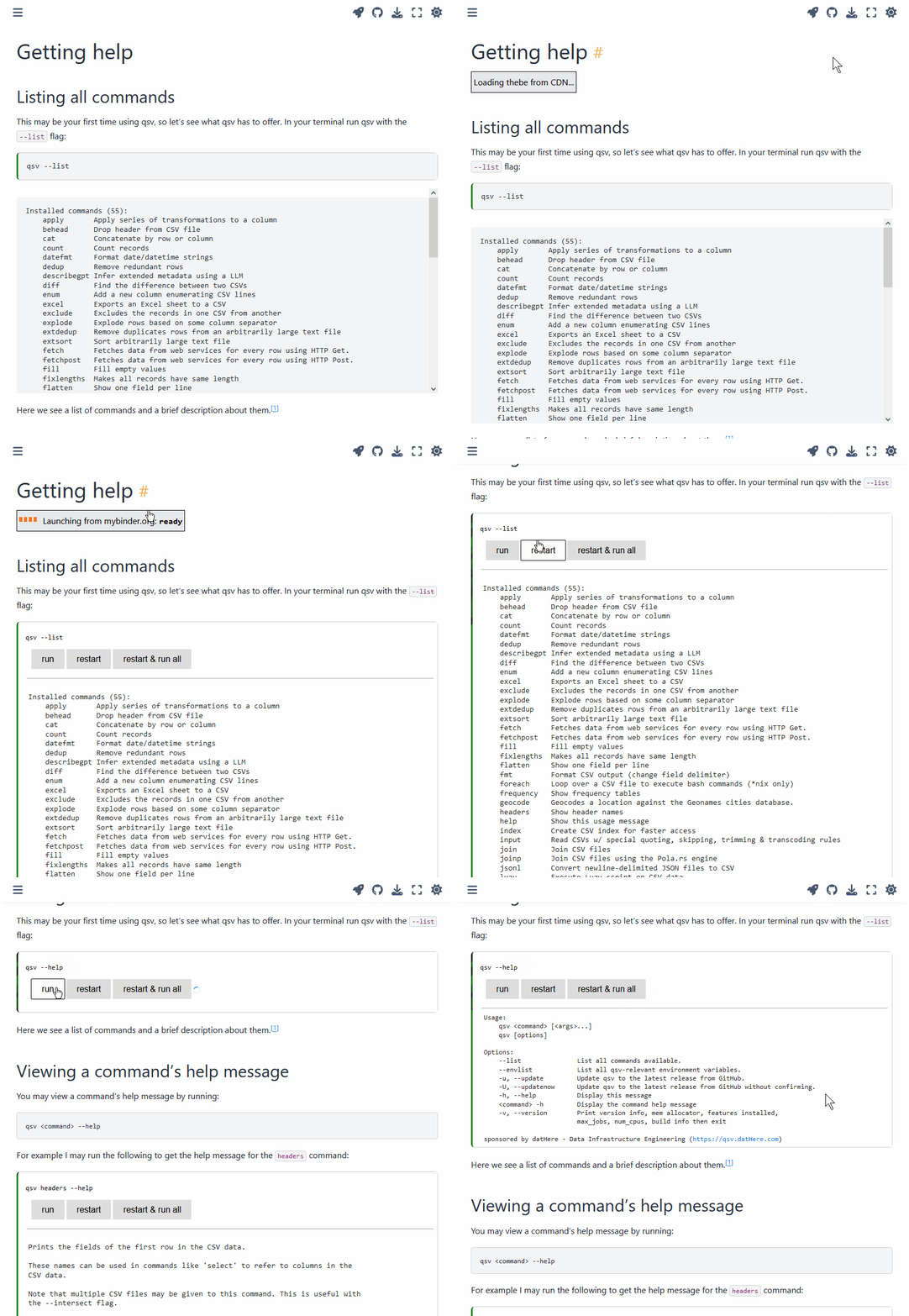
In the header for a lesson click the rocket icon and then in the dropdown click Live Code. Thebe should begin launching as shown in a new box that appears with its launch status. Once the status is set to ready (may take a few seconds/minutes), then you should be able to edit and run the code cell within the page by pressing the run button or pressing shift + enter when your cursor is within a code cell.
Here's a screen recording that shows how to do this for each lesson:
(exercises-setup:binder)=
Binder
In the header for a lesson click the rocket icon and then in the dropdown click Binder. Binder should be launching and once ready (may take a few seconds/minutes) an online Jupyter lab environment is set up for you to work with.
(exercises-setup:local)=
Local
You may choose to run the exercises on your system. The rest of this page is an overview of how to load the exercises and how to install qsv locally. You may continue to the next page instead if you won't do exercises on your system.
1. Download and extract the exercises
- Click here to download the
100.dathere.com.zipfile. - Unzip
100.dathere.com.zip. You may delete everything except thelessonsfolder.
As you follow along with a lesson page on 100.dathere.com, once an exercise appears then you may change directory into the relevant folder (e.g., cd lessons/0 for the first exercise). We recommend you ignore the notes.md file in each lesson folder as the lesson is rendered as intended on 100.dathere.com and the file may also contain the solution to the exercise.
2. Set up qsv
:::note
If you already have qsv installed on your system and accessible from PATH then you may skip to step 3.
:::
Download and extract qsv
You may download qsv as an executable file which you may run in a terminal like other commands. There are multiple ways to download qsv and multiple versions of qsv.
Here's one way to download the latest version (arbitrarily represented as version X.Y.Z). You may download the latest version of qsv from the latest releases on GitHub at: https://github.com/jqnatividad/qsv/releases/latest. Under the Assets section of the latest release you may find many files, so choose the right one based on your operating system and system architecture.
Here are the files we suggest if you're unsure:
| OS | Suggested file(s) |
|---|---|
| Windows | Run the qsv-X.Y.Z.msi installer and go through its installation process. |
| macOS | Depending on your architecture, choose between qsv-X.Y.Z-aarch64-apple-darwin.zip and qsv-X.Y.Z-x86_64-apple-darwin.zip |
| Linux | qsv-X.Y.Z-x86_64-unknown-linux-gnu.zip (the musl.zip may not have all of qsv's capabilities available but may have more compatibility with various Linux distros) |
:::{seealso} If you'd like to know more about each file, see the table for qsv release assets. :::
If you have a .zip file downloaded then make sure to unzip it and locate the qsv file within it (or qsv.exe for Windows). You may start using qsv with that file right away if you'd like!
Add qsv to your PATH
To ensure you may access qsv from your terminal in any directory without having to specify a path to the qsv binary file, you'll need to add qsv to your PATH environment variable.
If you used the qsv-X.Y.Z.msi installer for Windows then this should have already been done for you. You may verify this works by opening a terminal (Windows Terminal, Command Prompt, Git Bash, Powershell, etc.), type qsv --list, and press enter to run the command. This should output the list of available qsv commands as intended.
For macOS and Linux there are various ways to add qsv to the PATH. One way is moving the qsv binary file to /usr/local/bin, which you may do by changing your directory to where qsv is located and running:
sudo mv qsv /usr/local/bin
You may need to restart your terminal. Try running qsv --list, which should output the list of available commands.
3 (Optional). Set up qsv bash completions
Bash completions allow you to press the tab key at certain locations while typing a qsv command to get suggestions (completions) so you may view available commands, subcommands, and options within your terminal (assuming you're using a compatible terminal such as Git Bash on Windows).

You can download the current bash completions file from qsv's source code at contrib/bashly/completions.bash. Then you may run source completions.bash to enable the completions in your current terminal instance. You may also move completions.bash to your home directory (~/completions.bash) and also create a .bashrc file in your home directory (~/.bashrc) to include source completions.bash as a line within it for the completions script to run whenever you launch a bash terminal.
Recap
If you chose to do a local installation, then by now you should have the following available on your system:
- The
lessonsfolder - qsv (available from your PATH)
- qsv bash completions (optional)