
3.7 KiB
ladderz
The ladderz project is a collection of math and tech concepts implemented in code.
ladderzcrate - A Rust library crate for running concept implementations- notebooks - Jupyter notebooks with concept exercises and solutions in Python
If you're looking for a more efficient implementation of a concept (e.g., for use in your programs), other resources may be more useful.
ladderz crate
Demo
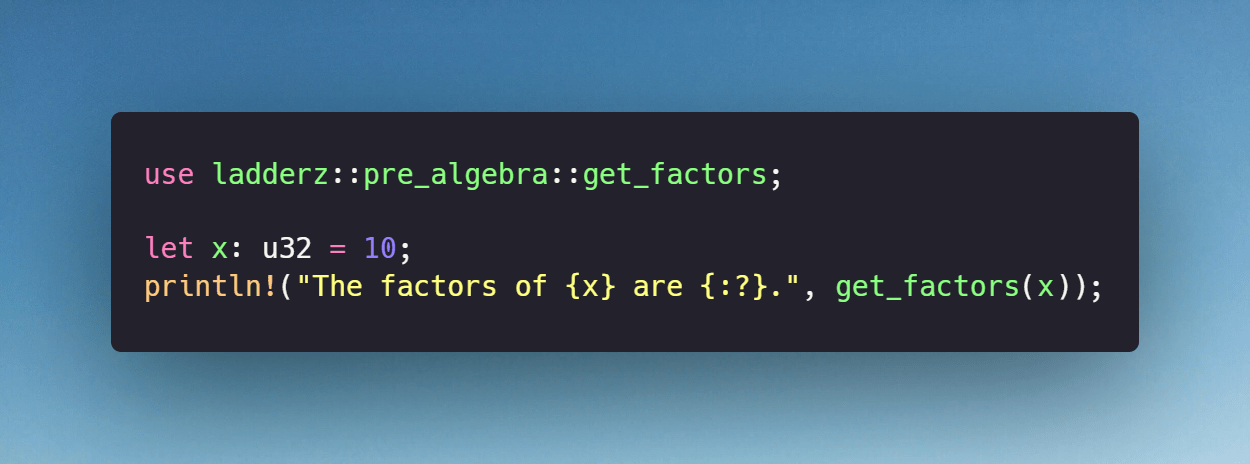
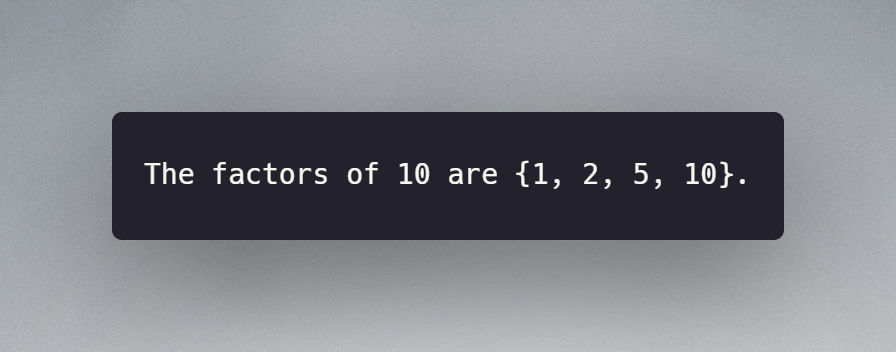
Example
Here's an example of using the ladderz crate to get the factors and factor pairs of a positive integer in sorted order.
First let's create a new Rust project and change into the project directory:
cargo new my_ladderz_project
cd my_ladderz_project
Then let's add the following to Cargo.toml under the [dependencies] section:
ladderz = { git = "https://github.com/rzmk/ladderz", branch = "main" }
Now in src/main.rs let's replace the contents with the following code:
use ladderz::pre_algebra::{get_factors, get_factor_pairs};
use std::env;

fn main() {
    // Get user input as a Vec
    let args: Vec<String> = env::args().collect();

    // Check if input was provided
    match args.get(1) {
        Some(_) => {
            match args[1].parse::<u32>() {
                // Handle input that can be parsed as a u32
                Ok(x) => {
                    // Convert the HashSet of factors of input x to a sorted Vec
                    let mut factors: Vec<u32> = get_factors(x).into_iter().collect::<Vec<u32>>();
                    factors.sort();

                    // Convert the HashSet of factor pairs of input x to a sorted Vec
                    let mut factor_pairs: Vec<(u32, u32)> =
                        get_factor_pairs(x).into_iter().collect::<Vec<(u32, u32)>>();
                    factor_pairs.sort();

                    // Print the results
                    println!("List of factors of {:?}: {:?}", x, factors);
                    println!("List of factor pairs of {:?}: {:?}", x, factor_pairs);
                }
                // Handle input that can't be parsed as a u32
                Err(e) => println!("Error parsing input: {e}"),
            }
        }
        None => println!("No input provided."),
    }
}
Now let's build the project's binary file so we can run it from the command line:
cargo build --release
Our runnable binary file should be located at the local path ./target/release/my_ladders_project (or ./target/release/my_ladders_project.exe for Windows). Let's run it with the positive integer 12 as input:
./target/release/my_ladderz_project 12
If you have a .exe file instead, you can run it with:
./target/release/my_ladderz_project.exe 12
The printed output should be:
List of factors of 12: [1, 2, 3, 4, 6, 12]
List of factor pairs of 12: [(1, 12), (2, 6), (3, 4)]
We've successfully used the ladderz crate to get the factors and factor pairs of a positive integer in sorted order.
Ideas
Not currently implemented, but ideas that may be useful:
- Extend to:
- Algebra
- Precalculus
- Calculus
- Linear Algebra
- Statistics
- Discrete Math
- Algorithms
- py-ladderz - A package for running implementations of mathematical concepts in Python
- ladderz CLI - A CLI tool for ladderz in Rust
- ladderz App - An interactive multi-platform (web, desktop, mobile) app potentially including visualizations, practice problems, & a course-like structure (potentially in Flutter or Tauri with Next.js & Rust)